Radiation Protection Services
Standards & Regulatory Compliance Support
Consultancy on compliance with national radiation safety legislation and relevant standards.
Standards and regulatory compliance support is a technical consultancy service aimed at ensuring that organisations holding ionising radiation sources, or operating with such sources, comply with national radiation safety legislation and the relevant international standards. The scientific framework on which the service rests consists of the three fundamental principles of the International Commission on Radiological Protection (ICRP): justification (the benefit provided by a practice must outweigh the risk it creates), optimisation (keeping the dose received as low as reasonably achievable — the ALARA principle) and dose limitation (individual doses remaining below the legal limits). In Türkiye the authority regulating this field is the Nuclear Regulatory Authority (NDK), established by Nuclear Regulation Law No. 7381; the holding, use and transfer of radiation sources are subject to a licensing and authorisation regime.
Compliance support typically starts with a current-state (gap) analysis. At this stage the source inventory held by the operator, the existing written procedures, the personnel structure and the physical infrastructure are systematically compared with the requirements of the Radiation Protection Regulation in force and the relevant technical standards. The aim is to set out objectively the gaps between the obligations foreseen by the legislation and the actual practice in the field (such as a missing permit, an out-of-date document, an undefined responsibility or inadequate area classification). This comparison is carried out over a checklist that refers to the relevant regulatory article and standard clause rather than to subjective judgement.
On the technical side, compliance rests on measurable and traceable elements. The exposure of radiation workers is continuously monitored with personal dosimeters (TLD, OSL or film dosimeters), while working environments are classified as controlled areas and supervised areas on the basis of dose rate measurements. The physical security of sources is ensured through leak tests and periodic maintenance records; the organisational structure is ensured through an appointed Radiation Protection Officer (RPO) and a written radiation protection programme. Compliance support verifies the existence, currency and recording of each of these components.
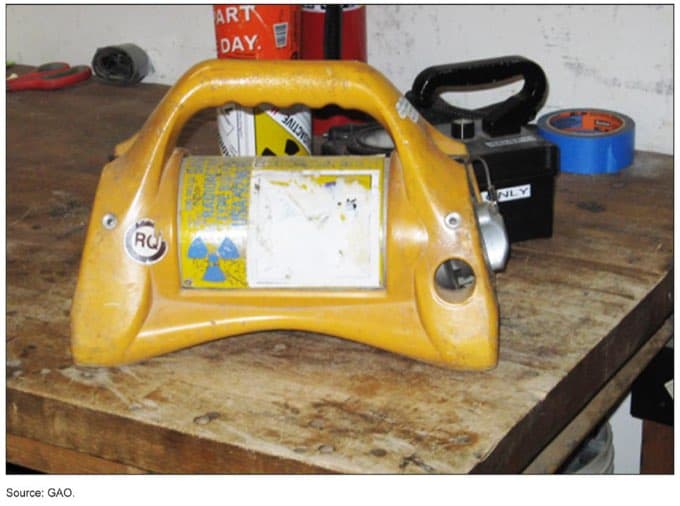
In industrial radiography (non-destructive testing) applications this framework acquires particular depth. Gamma radiography devices (with Ir-192, Se-75 or Co-60 sources) and X-ray generators are among the applications requiring the strictest control, both because of their high dose rates and because they are used portably in the field. In this area compliance covers source transport and storage conditions, barrier and safety distance calculations for field exposures, the functionality of the interlock and warning systems on the equipment, and the emergency response plan prepared for a possible source jamming scenario. The design and performance requirements for such equipment are defined by standards such as TS EN ISO 3999.
The output of the work is a compliance assessment report that links every non-conformity identified to the relevant legislative/standard clause and prioritises it according to its significance. The report does not merely list deficiencies; for each finding it proposes an applicable corrective action and a realistic closure priority. The value of this approach is twofold: on the one hand it provides technical assurance for the protection of worker and public health, and on the other it supports the operator in being ready for regulatory inspections and in reducing the risk of possible administrative sanctions. Radiation safety thus becomes a sustainable management discipline rather than a one-off documentation exercise.
Method
The work starts with defining the scope and collecting the source inventory together with the existing document/permit set (preparation). The operator's actual practices are then compared clause by clause, using a checklist, against the Radiation Protection Regulation in force and the relevant technical standards, and the dose monitoring, area classification and measuring equipment calibration records are reviewed (assessment/set-up). During the site inspection, the boundaries of controlled/supervised areas, source security and emergency arrangements are verified in situ (implementation). The non-conformities identified are classified by significance (critical/major/minor) and prioritised on a risk basis (evaluation). In the final stage a compliance assessment report is issued that links each finding to the relevant legislative/standard clause and proposes corrective actions and a closure schedule, and personnel briefings are provided on the topics deemed necessary (reporting).
Applications
- Industrial radiography (gamma and X-ray) inspection facilities and field teams
- Industrial operators holding and transferring radioactive sources
- Production facilities using thickness, level and density measuring devices (nuclear gauges)
- Personal dosimetry and worker dose monitoring programmes
- Radiation source storage, transport and security arrangements
- Design and classification of controlled and supervised areas
- Radiation Protection Officer (RPO) and protection programme organisation
- Emergency and source loss/jamming response planning
- Document preparation for NDK licensing and authorisation processes
Frequently asked questions
Related services
Radiation Protection Training
Radiation protection and safety training for personnel working with radiation.
View detailsRadiation Protection Plan Preparation
Preparation of a regulation-compliant radiation protection plan covering the inventory of radiation sources, dose constraints and protective measures.
View detailsWorkplace Radiation Measurement Plan and Implementation
Establishment of a measurement plan for radiation levels in the workplace and execution of the corresponding field measurements.
View detailsShielding Calculations and Applications
Calculation of the shielding material and thickness required against radiation sources, together with implementation support.
View detailsGet a quote for your project
Receive a fast, GDPR/KVKK-compliant response for the inspection or certification service you need.