
Radiation Protection Services
Radiation Protection Training
Radiation protection and safety training for personnel working with radiation.
Radiation protection training programmes are structured technical courses that enable personnel who work with ionising radiation sources, or who work in areas where such sources are present, to understand the biological effects of radiation, the exposure pathways and the methods of protection. Ionising radiation covers forms of energy — such as X-rays, gamma rays, alpha and beta particles and neutrons — that create ion pairs by ejecting electrons from atoms as they interact with matter. Because this ionisation can cause damage to cellular structures and DNA in living tissue, keeping the dose received by people working in industrial radiography (RT), nuclear medicine, thickness measurement systems and similar applications under control is both a legal and an ethical obligation. The fundamental aim of the training is to present radiation to personnel as an invisible but measurable hazard and to instil the discipline of keeping exposure as low as possible.
The core of the training consists of the three fundamental principles of radiation protection: justification (weighing the benefit against the harm of a radiation practice), optimisation (keeping the dose as low as reasonably achievable, i.e. the ALARA – As Low As Reasonably Achievable principle) and dose limitation (individual exposure remaining below the limits set by legislation). In practice these principles translate into three concrete protection parameters: time, distance and shielding. Shortening the time spent in a radiation field directly reduces the dose received; moving away from the source is a highly effective protection method because the dose rate falls in inverse proportion to the square of the distance (the inverse square law); and shielding with high-density materials such as lead, concrete or tungsten attenuates the radiation intensity as a function of the half-value layer of the material.
In the practical part of the training, the objective is for personnel to use dose and dose rate measuring instruments correctly. Determining the dose rate in the working environment with area survey instruments (Geiger-Müller counters, ionisation chambers) and monitoring individual cumulative dose with personal dosimeters (film dosimeters, TLD/OSL badges, electronic pocket dosimeters) are addressed. Dose equivalent units such as the sievert (Sv) and its derivatives, the millisievert (mSv) and microsievert (µSv), the concept of dose rate and the setting of alarm thresholds form the measurement dimension of the training. Marking the boundaries of controlled and supervised areas, the meaning of warning lights and audible alarms, and the rules for source transport and storage are also conveyed.
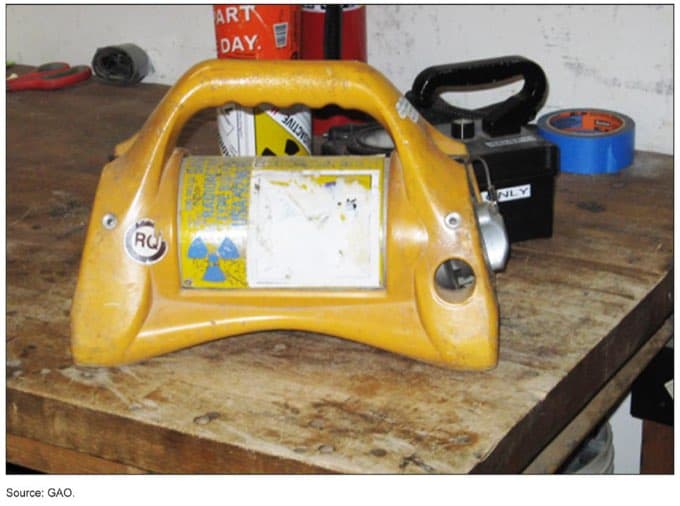
Modules specialised for industrial radiography cover the safe operation of gamma sources (Ir-192, Se-75, Co-60) and X-ray tubes, the use of the projector (camera), confirmation that the source has been returned to its safe position, and the reduction of scattered radiation through the use of collimators. Operational steps such as dose rate mapping before an exposure in the field, determining the barrier distance according to dose rate and physically isolating the exposure area are explained with examples. Emergency scenarios such as the source failing to leave the projector or failing to return to its shielded position, together with the corresponding response procedures, are reinforced with drills so that theoretical knowledge becomes a field reflex.
The training process is completed by measuring the participant's level of theoretical knowledge and practical competence. The assessment examination held at the end of the programme objectively documents whether the topics covered (principles, legislation, measurement, emergencies) have been understood; the success criterion is meeting a predefined pass threshold. Attendance and assessment results are recorded, a training certificate is issued, and the personnel training history becomes part of the employer's radiation safety management records. This documentation gives concrete form both to the worker's informed behaviour and to the organisation's responsibility for regulatory compliance. The real value of radiation protection training emerges not as a paper formality but as measurable dose reduction and prevented accidents in daily operations; an informed operator is the most effective layer of protection, permanently lowering the exposure of both themselves and those around them.
Method
The training process starts with an analysis of the job descriptions of the participant group and of the radiation types they may be exposed to (X/gamma, beta, neutron); in the preparation stage the training content is defined and the calibration validity of the dosimeters and area survey instruments to be used in the measurement demonstrations is confirmed. The theoretical part covers radiation physics, biological effects, the principles of justification–optimisation (ALARA)–dose limitation and the parameters of time, distance and shielding; the correct use of personal dosimeters and survey instruments, dose/dose rate reading and alarm threshold settings are then demonstrated practically. In special applications such as industrial radiography, field scenarios (determining barrier distance, confirming source retraction, emergency response) are reinforced with drills. In the evaluation stage the knowledge and competence of participants are measured by a written and/or practical examination; for participants meeting the defined pass criterion the results are reported and a training certificate is issued and entered into the organisation's radiation safety records.
Applications
- Non-destructive testing personnel performing industrial radiography (gamma and X-ray)
- Petrochemical, refinery and power plant site inspection teams
- Weld inspection operators in pipeline and pressure vessel manufacturing
- Facilities transporting, storing and using radioactive sources
- Users of thickness, level and density measurement systems (nuclear gauges)
- Radiation safety officers at operators holding radiation sources
- Support and supervision personnel working in inspection areas
- Occupational safety specialists and emergency response teams
Frequently asked questions
Related services
Radiation Protection Plan Preparation
Preparation of a regulation-compliant radiation protection plan covering the inventory of radiation sources, dose constraints and protective measures.
View detailsWorkplace Radiation Measurement Plan and Implementation
Establishment of a measurement plan for radiation levels in the workplace and execution of the corresponding field measurements.
View detailsShielding Calculations and Applications
Calculation of the shielding material and thickness required against radiation sources, together with implementation support.
View detailsManagement of NDK Licence and Permit Processes
Management of licence and permit applications and their follow-up before the Nuclear Regulatory Authority (NDK).
View detailsGet a quote for your project
Receive a fast, GDPR/KVKK-compliant response for the inspection or certification service you need.