Drilling Equipment Inspection
Rig Inspections
Rig suitability, safety and condition assessment surveys together with project engineering and QA services.
Rig Inspections are condition-based and time-based periodic inspection activities that holistically assess the structural integrity, fitness for service and occupational safety status of a drilling rig. A drilling rig is a complex system operating under heavy dynamic and cyclic loads, comprising the derrick/mast, the substructure, the hoisting system (draw-works, crown block, travelling block, hook, swivel), the rotary system and the power units. Throughout their service life these components accumulate progressive damage through mechanisms such as fatigue, corrosion, wear, plastic deformation and loosening of connections. The fundamental engineering principle of the inspection is to detect this damage accumulation before it reaches a critical size and to verify the remaining capacity (fitness for purpose) of the load-bearing members.
The work is carried out through an internationally accepted category system. The Category I–IV approach defined in API RP 8B (hoisting equipment) and API RP 4G (structural members) grades the depth of the inspection: Category I is continuous observation during operation, Category II is regular visual and functional checking, Category III is detailed inspection requiring disassembly together with non-destructive testing (NDT), while Category IV covers full disassembly and NDT of all primary load-bearing members. The inspection engineer determines the appropriate category and scope by taking into account the operating history of the rig, previous inspection records and the load cycles to which it has been exposed.
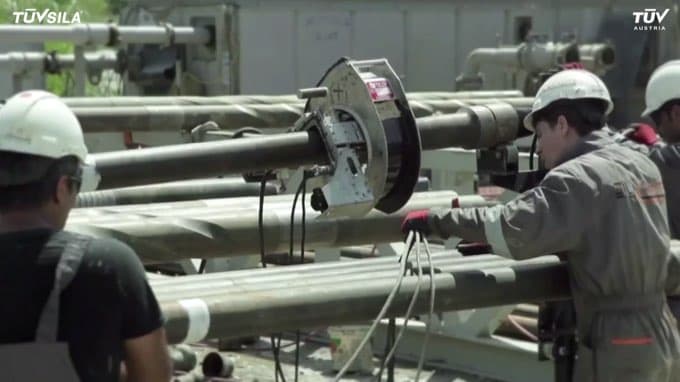
In technical execution, visual inspection, dimensional measurement (pin/bore wear, ovality, wall thickness) and non-destructive testing are used together. Magnetic particle testing (MT) or penetrant testing (PT) is applied to capture fine surface cracking in welded structural joints and load-bearing pins, while ultrasonic testing (UT) is used for wall and through-section discontinuities and corrosion thinning. The drilling line, the dead line anchor, the elevator, the links/bails and the draw-works braking system are additionally evaluated for wear, broken wires and deformation. Where required, load tests and function tests are performed to verify the lifting capacity.
At an application-specific level of depth, rig inspections serve three main purposes: acceptance/suitability surveys (rig acceptance / suitability survey) that verify a new or newly acquired rig against the specification and site conditions before commissioning; condition assessment surveys that establish the overall health of an operating rig; and project-based engineering with quality assurance (QA/QC) support. Dropped object prevention (DROPS) surveys, certification of lifting accessories and site occupational safety audits may also be included within this scope. In this way both the safety of the operator and of the site personnel and the operational continuity are safeguarded.
Reporting covers the findings identified for each inspected system and component, the measurement results, the NDT methods applied and the photographic/sketch records. Each finding is evaluated against the acceptance criteria of the relevant standard and classified as acceptable, conditionally acceptable (requiring repair or monitoring) or non-conforming. Where the acceptance limit is exceeded on a critical load-bearing member, the rig is recommended to be taken out of service until the necessary corrections are made. The final report presents the actual condition of the rig, its remaining capacity and the priority repair/maintenance items transparently to the operator and therefore constitutes evidence for asset management and for legal and contractual obligations.
TÜV AUSTRIA SILA KALİTE performs rig inspections as an inspection body accredited to TS EN ISO/IEC 17020, within the principles of impartiality and independence; inspections are carried out and reported by competent personnel on the basis of the applicable API and ISO requirements.
Method
Before the inspection, the technical documentation of the rig, the manufacturing/design specification (API Spec 4F etc.), previous inspection records and the operating history are reviewed in order to determine the appropriate inspection category (API RP 8B / API RP 4G Category I–IV) and scope; an access, disassembly and occupational safety plan is prepared. The NDT equipment to be used (UT, MT/PT equipment) is calibrated against the relevant reference blocks and standards, and the traceable calibration of the measuring instruments is verified. During site execution, visual inspection, dimensional measurement and non-destructive testing are carried out together; load-bearing structural members, hoisting components, the drilling line and functional/safety systems are evaluated, and load and function tests are performed where required. The findings obtained are classified as acceptable/conditional/non-conforming against the acceptance criteria of the relevant standard and interpreted in terms of remaining capacity and risk. The results are documented in an accredited inspection report containing the findings, the measurement and NDT data, the photographic records, the category and acceptance assessment and the priority repair recommendations.
Applications
- Land drilling derricks/masts and the substructure
- Well completion and workover units
- Hoisting system components (crown block, travelling block, hook, swivel)
- Rotary system equipment (rotary table, top drive, swivel)
- Drilling line, dead line anchor and draw-works/winch systems
- Elevators, links/bails, spiders and manual handling tools
- Oil, natural gas and geothermal drilling rigs
- Lifting accessories and dropped object prevention (DROPS) surveys
- Rig acceptance and suitability audits for new or newly acquired rigs
Frequently asked questions
Related services
Drill Stem Inspection Services
Inspection of service- and transport-induced defects, corrosion and discontinuities to API / DS-1 Cat 1-5 standards.
TÜRKAK 17020 · AB-0120-MView detailsDrilling Hoisting Equipment Inspections
Periodic inspection, non-destructive testing and load testing of drilling hoisting and handling equipment.
TÜRKAK 17020 · AB-0120-MView detailsGet a quote for your project
Receive a fast, GDPR/KVKK-compliant response for the inspection or certification service you need.